Monday, November 12, 2007

Coming next month: Endura Pads!


Homemade Mama's newest product!
EnduraPad!
Pads with endurance to go the distance!


HomemadeMama’s EnduraPad is a brand new innovation in Cloth Menstrual Pads. For those who desire a pad that will go the distance! Whether you’re into sports, running after your children, or in need of a great pad for incontinence, the EnduraPad is for you!

The EnduraPad has been created with athletic performance fabrics! The top layer is constructed of athletic performance fabric which will wick moisture away from your body
and keep you feeling cool.

Just see for yourself the wonderful list of features and characteristics of this amazing fabric:

  • Anti-bacterial
  • Biodegradable
  • Clean and hygienic
  • Durable and washable
  • Odor resistant
  • Non-toxic
  • Pilling resistant
  • Anti-static
  • Breathable
  • Fast drying
  • Moisture management & wicking
  • Soft
  • Environmentally friendly

Our unique backing layer is created with another new athletic performance fabric which is waterproof, yet breathable. The unique waffle weave of the backing fabric allows for a non-slip ‘grip’ for the back of your pad.

The perfect combination for women on the go!
Endura pads and other organic homemade mama's pad will be in store estimated on December 2007!
Another additional is the original ULTIMATE PADS

Homemade Mama's Ultimate Pad

This pad is like no other pad you will find! Created exclusively by Homemade Mama, for those who need the ultimate night time protection!
The length of this pad is over 16 inches! The widest parts of this pad are almost 8 inches!
The front and back ends provide for ultimate coverage, with the back being especially wide. Extra attention was given to the special wings.

These will be the last heavy pad you will ever need to try!
No more leaks to worry about overnight or after the birth of a babe!
Just soft comfort, for your body and your peace of mind.
ULTIMATE PADS will be available in dyed bamboo velour fabric

Wednesday, November 7, 2007

TLC for your washing machine

Just because the name is "washing" machine, it doesn't meant it can "wash" it self automatically.
We often forget, washing machine , just like any other home appliances need a good care to pro-long its life , also to avoid any damage and to be able to perform at its best.

Your washing machine needs a good clean time from time to time. Let's say once every 3 months.

The detergent build up , harden and clumped softener and bleach can lead to odor problem, or even stain your laundry.

The basic guide, that I do with my WM:
1. If you have top loader WM ( washing machine) , usually there is a small net/bag to catch any residue of fabric or dirt. You must clean this often, just by washing it under tap water.
2. Wash regularly the detergent "drawer" and wipe it with paper towel.
3. The softener and bleach container inside the WM , can't be remove. So what I do is , pour hot water into it ( while the WM is empty). This will dissolve any clump of harden softener / bleach.So the water will ended up inside the tub, then:
When I do #3 step, usually I will wash my rag, kitchen towel, carpet ( the one to dry /clean our feet in front of the door, not a "real" carpet)
4. Wipe the tub top part with rag/paper towel.
5. This step I do once every 2 months or so:
Still doing the step 1-4 above, but I will also do:
I will pour hot water ( my WM doesn't have hot water option) in to the tub.
Normally I put about one big pot of hot water. Then I run the WM in the lowest amount of cold water.
If your WM (top loader or front loader) has a hot water option , just run it with the highest temperature.
6.When the tub is almost full, add 2-3 cups of distiled vinegar and 1/2 cup of baking soda.
Additional : I also put baking soda in the place of detergent powder and pour vinegar in the bleach and softener container, after I pour hot water into it. Just to help it flush out any residue.
7. Run of WM in a full cycle ( until it drains)
8. I will do an extra cycle in economy or fast cycle or if you can just run in one cold cycle.
DONE....

If you wash cloth diapers with your WM and you are using softener with your other laundry, it is important to clean the softener' container or cup regularly . To avoid any unwanted softener run over your diaper's stash. Or you can also add water into your softener when you pour it into the container/cup to make it thinner/diluted . Or better yet, you can consider to use distilled vinegar instead of fabric softener.

Sunday, November 4, 2007

How GREEN can you go?


The November Reader's Digest cover has caught my attention with the title of BEING GREEN, and articles likes: Solving Asia's Garbage Problem, and What YOU can do!

The feature stories is included: It's time to clean up by William Ecenbarger. This is some of the highlights:

An out-of-control garbage crisis threatens the physical and economic health of much of Asia


As we become wealthier and consume more, we are producing unprecedented quantities of rubbish. The Asian Development Bank (ADB) estimates that our largest cities produce on average 760,000 tons of solid waste per day. It predicts that there will be a two-fold increase – to 1.8 million tons – by 2025.

This is of course make me scare. The garbage issue in Asia is getting so serious. How many of us think that we can really help by doing some simple step into our daily life?
People take our life style by granted. We think it is a modern time so what we do is just normal or acceptable for our time because what we need now is something that is convenient , and easy to use to suit our busy and demanding life. So in the marketing world the wording like: disposable, use and toss, no fuss is highly sell able now a days.

I remember clearly that , my mom re-use all the margarine's containers and pack my and my sibling snacks in it. I didn't have any Barbie, or Dora lunch box that time. Of course the main reason my mom did this because she wanted to save money.

My mom also had a rattan/wooden basket that she brought everyday to the market , and put all the vegetables, fish, and meat in it. She doesn't want to deal with the dirty plastic bags . And I think this is a great way to reduce the waste of plastic bags.

My late grandma used to kept the water that she used to wash rice grains in a bucket and used it to watered her plants. She said that the water from washing the rice grains has vitamins in it and it is beneficial for the plants. I am glad she saw it that way. At least she is re-using a half bucket of water a day.

But since our quality if life in term of financial is getting better that our parent's time, we also afford many thing and consume much more than our parent's generation.

Much of the added burden is packaging from consumer products and the products themselves – all of which need years, even centuries, to decompose. Lindfield cites estimates that four of every five products we buy are discarded after a single use.It all makes the handling of solid wastes much more complicated and expensive

No-one can avoid the consequences of the uncontrolled garbage glut. ''When an environment is being polluted, everyone, regardless of his or her economic status or functions, suffers,'' says Dr Wahid Murad, a solid waste management specialist at Multimedia...

The ADB says the growing garbage crisis must be counterered by the 3 R's:

-Reducing the amount of waste,

-Reusing items that are now being discarded

-Recycling materials.


This is the thing that we should try to do. By reducing garbage everyday , reusing plastic bags, re-cycling news paper , magazines, brochures, old bills if you have baby , use cloth diapers.
I also keep all the cartoon boxes from the toilet paper , cartoon boxes of juices/milk, used envelopes , then once a month I sell it to the local recycling paper company. I do have problem with plastic bottles and container. I couldn't find any recycling company that willing to take/buy plastic botlles/container in Kota Kinabalu. If you happen to know one , please let me know.

Another great thing ,I heard from a friend that from the metal bottle taps of any bottles drinks, from beer bottles specially, can be remake into a wheelchair . This is a great news, imagine that something that you throw away can be so useful for other people.
I appologize that I can't recall the association's name now, I just want to make sure I mention the correct name .

And it is not too late to start doing the right thing.Everyone can do their part."It is not difficult to put recyclable items into plastic bags or put them into recycling bins near our homes" says Yaacob Ibrahim, Singapore's Minister for the Environment and Water Resources. " What would appreat as a small inconvenience initially is nothing compared to the benefits that will accrue to pur enviroment and livelihood in the long run."


How lucky am I to be a cloth diaper's mom. I know I am doing the right thing to our environment and I enjoy every second of it! You also can do something, find something simple do, and start to reduce our waste!

During my recent trip to China, I saw there are many young ladies using a canvas tote , I think it is the new trend over there, with the green writing of : I AM NOT A PLASTIC BAG RE-USE ME! or " PROUD TO BE A RE-USABLE BAG". I think the bags are so cute and sending a great message to people.

There are so many other things we can do to be gentler to our Planet. Our children deserve to live in a better place.

Heal The World
Make It A Better Place
For You And For Me
And The Entire Human Race
There Are People Dying
If You Care Enough
For The Living
Make A Better Place
For You And For Me

Here is a bonus for you:


Never even think of......

When the first I started this blog a few months back, I never thought that the blog can be read "worldwide." My main goal is to offer a better explanations with photos about cloth diapers to my friends and customers from mia bambina.

I am not a good writer and English is not my mother tounge. I just write this blog for friends or Local moms who wants to know more about cloth diapers, since I thought at that time, it is a bit hard to find a local informations about CD or to find a real mom who lives near by me who happen to use CD just like me. So that's how this blog was born and well as my humble Forum.

So when I received a comments from overseas readers, I was stunned. They visited my blog? OMG, did I write correctly? Did I made mistake? and all of many other worries.....
When I wrote about the book "parentpreneur" and the Author of the book It self put a comment, I feel honour of course, but also I thought " MALU -NYE" in Malaysian mean: embarrassed ...my blog been read by a real author like her!

I just found a great new website a few days ago www.clothdiapernews.com
from Julia and to my surprise I found an article taken from my blog about laundering tips!
and today I just an new article about Malaysian cloth diaper's mommies .
I am excited because it is just great to let other people know that cloth diapers are really making a big come back all over the world!

In year of 2006 alone , there are several new online stores selling cloth diapers started to open all over Malaysia. This is a good sign, of course, as I believe that means they are more moms hooked up with cloth and want to spread the news about cloth diapers.

Saturday, November 3, 2007

DryBees to participate in Babes in Toyland Gift Promotion

DryBees is proud to announce that they have been selected in the “Babes in Toyland” gift promotion. The Babes in Toyland event provides gift baskets to celebrities with children under two.

What will the selected celebrities’ children be getting in their stockings this year? Each family selected will be receiving 2 of DryBees newest Hybrid AIOs. What is a hybrid? It isn’t a pocket, it isn’t an AIO - it is both. For those that love AIOs but some times need a bit more this is the daiper for you. Where can you find these newest additions to cloth diaper wonderland? Check out or authorized retailers at DryBees .

Give one a try and put your baby bum in the same luxury that the star’s babies will have this season. Identical gift bags are also sent to the media for review. Some of the selected families may include:
GWEN STEFANI
MARCIA CROSS
JILLIAN BARBERIE
TORI SPELLING
NANCY O’DELL
JULIE BOWEN
WILL FERRELL
DAVE MATTHEWS
JAIME PRESSLY
SALMA HAYEK
TIGER WOODS
KIM RAVER
JENNA ELFMAN
BRIDGET MOYNAHAN
POPPY MONTGOMERY
ANGELINA JOLIE & BRAD PITT
NAOMI WATTS & LIEV SCHREIBER
DIANA KRALL & ELVIS COSTELLO
PLUS MORE…

Lisa Adkins is the owner of DryBees and Wahmies and is the mother of two. She and her husband reside and raise their children in the beautiful hills of Southern WV. She started her business in 2003 and her life has never been so busy and fulfilling.

taken from www.clothdiapernews.com


Wednesday, October 31, 2007

Wool covers and wool care


Personally I've been read and browse about wool cover since I just started cloth diapering my dd over a year ago. But I didn't think it will be suitable for our tropical climate in Malaysia.

After searching and browsing about wool covers, I've decided about 3 months ago to try one wool cover for my dd. Why must try for 3 months ? :) well this is just me, I want to be sure that is suitable for Malaysia's climate and I also aware that wool need a special care (not hard but very easy)I want to share to all of you on how to take care and wash and how to lanolized the wool.
I think a few month of usage will be just right to share to others (not an expert yet, 3 months is just a short time ). I personally think by using or trying a product one or two times doesn't means I can share the goodness to other moms.
I want to make sure that wool cover doesn't mean that it's hard to be taken care off, or it will be too hot to be use over here. I want to try to wash it a few times and how long it will take me before I need to lanolized . This info can be found easily over the internet of course, but I just need to experience it my self before I have the confidence to share to all of you.

Wool,however does need a special care. So this is why I need to use it for a few months before I can post this blog. I want to share and give a proper info to my customers ,when they ask me: is it hard to wash wool? is there many steps to do? how to wash? can i use washing machine? what kind of soap can I use?

I am aware to that wool cover and wool care are still new in Malaysia . As I want to offer a one stop cloth diapering shopping to all of busy moms, If I will carry wool covers in my e-store I also will need to carry a line of wool care. Well I am happy to announce that wool cover and a line of wool care will be available soon at Mia Bambina.

Here is some info about wool. (taken from thesheepishgrins.com)

What is Wool?
Wool is the “hair” from a sheep. It is a renewable resource and is shorn from the sheep without injuring the animal. One reason wool is so popular is that the best wool is grown without any harm to the animals. Wool is biodegradable, so after your wool product has outlived its usefulness, it will break down into the soil - unlike plastic or polyester. Wool is a complex protein that keeps warm blooded animals properly temperature controlled in many different climates and temperatures. Just like human hair, wool requires gentle washing and conditioning to keep it soft and healthy.
Isn’t Wool Hot?
No, in fact wool has the unique ability to act as a breathable insulator. It helps keep the body at an even temperature and does not conduct heat. This means that during hot or cold weather it will keep you at a constant temperature. This is due to the small pockets of air formed by the fibers of the fabric.
Why is wool used to make diaper covers?
Wool diaper covers (also called soakers) are breathable and environmentally friendly. Wool has been used as a water-resistant cover for diapers for generations. It was only with the advent of rubber pants that wool soakers fell out of favor. Clean, lanolized wool covers will absorb 30% of their weight in moisture before they feel wet.
Lanolin on wool interacts with the ammonia in urine to form a soap. This makes wool covers 'self-cleaning'. Just hang them to air dry and they will stay fresh smelling for several uses. About once every week or so they can be handwashed in a lanolin rich soap. Every 3-4 weeks they will need lanolized to restore their amazing ability to neutralize urine odors.

Because it is breathable, wool is a natural choice for babies with sensitive skin. Their skin stays dryer and they stay happier.
Hand knit or crocheted diaper covers and longies (long pants) are regaining popularity as more moms and dads discover the unique benefits of this natural fiber.

Cool Wool Facts:
*Wool is very resilient – it can be bent and stretched over 20,000 times and still not damage or break. Compare that to only 3,000 times for cotton and 2,000 times for silk. Properly cared for wool can last more than one generation.
* Wool is naturally flame-resistant and will resist burning.
*Wool has natural elasticity that allows it to be stretched as much as 1/3 of its length and still snap back into shape.
*The complex cellular structure of wool allows it to absorb moisture between the cells but still give the feeling of being dry. Wool naturally moves moisture from the wet side of the fabric to the dryer side. This helps it to evaporate extra moisture, making wool a great choice for a night time diaper cover.


My 2 cents:
I try 2 wool covers , please note that wool cover is different from wool soaker . Wool soaker normally is knited and it is form like pants or wrap. While wool cover is just like other diaper cover, the closure can be made by aplix/velcro or snaps but the body is made out of wool. Merino wool is the most popular wool for cover.

By using wool cover for my dd, I found that wool is extremely thin! It is thinner than fleece cover! I was thinking that wool must be thick!
I use the wool cover at night together with any fitted diaper but my favorite is with Drybees bamboo fitted. It gives my dd the complete"natural" diapering system! :-D
It is soft and very breathable! I just love it. Wool cover cost more than other covers, but you will need much less than other covers. I have 2 wool cover so far.

After used , the wool will smell a bit, but after I air dried it, it smell like new again! Amazing.
I wash the cover every week or 10 days , or if it's soiled.

And I lanolized it every 3-4 weeks.

Washing wool
Many of wool covers available in the market now can be wash inside the washing machine in gentle cycle. You must refer to the manufacture guide.
How ever I hand washed mine.

I just wash and rinse the wool cover with tap water(room temperature), and then soaked it with baby shampoo , if there is no wool wash available. It will be better if you wash it with a lanolin rich soap .
After that just take a towel, put the cover in between and squeeze the towel , so it will absorb most of the excess water from the cover. Air dry the cover.....
That's it!

Lanolizing wool.
Don't feel scare when you read "lanolized" :) it is very easy to do.
before that , please read the lanolin info (take from the sheepishgrins.com)

What is lanolin?
Lanolin is a greasy, yellow substance that is produced by sheep to keep their wool dry and soft. It is extracted from wool fibers through a chemical process. Because there is no way to remove lanolin organically, there is no such thing as an organic lanolin.
When purified, lanolin is used as a base for ointments and creams, as a lubricant, and in finishing and preserving leather. It is also a constituent of some varnishes and paints. Lanolin is made of a mixture of cholesterol and the esters of several fatty acids. With water it forms an emulsion. As a waste product in wool processing, it is known also as wool wax, wool fat, or wool grease.

Why Do My Wool Soakers Need Lanolin?
Lanolin is what keeps the sheep’s own wool dry and helps to neutralize urine. Lanolin is what keeps the water out. In the case of your wool soakers you want to keep the water in. Lanolin also reacts with your baby's urine and neutralizes it. This is why you can hang a wet soaker up to dry and have it still smell fresh without washing.


How Often Do I Need To Lanolize?

When your soaker is no longer waterproof or starts to smell it is time to wash and reapply the lanolin.

How Do I Lanolize My Wool?
First wash your wool in luke warm water using Sheepish Grins Wool Soap or Sheepish Grins Foaming Wool Soap. This soap is gentle for your wool but still has all the cleaning power that you need.
Drain water.
You can add just teaspoon of Sheepish Grins Solid Lanolin mixed with boiling water and a teaspoon of baby wash. Mix to smooth out any clumps, then add to warm water to cover your soaker:
Add your wool soaker to water and swirl it around. Allow it to soak in the water for a minimum of 15 minutes and as long as 24 hours.Remove from soak water and roll in a towel to remove excess water. Lay the soaker flat and allow to air dry.
Remove from soak water and roll in a towel to remove excess water. Lay the soaker flat and allow to air dry.

What Is The Spray Lanolin For Then?
This is the easiest way to lanolize your wool. After you wash your wool you just spray your soaker inside and out with Sheepish Grins Lanolin Spray. Massage gently into the fibers and allow to dry as usual. No clumps of lanolin anywhere and you can control how much or how little you add to your soaker.

I lanolized my cover before I have the special lanolin , so what i use is the 100 % pure nipple cream made from lanolin ( like lasinoh) the solid lanolin can also be use as nipple cream , lip balm and to moisturized a dry and cracked skin.

I know that the first time you read about lanolizing wool can be confusing. So keep coming back to my blog, I will blog with photos on how do I lanolize my wool covers.


Friday, October 12, 2007

About bamboo fabric

Bamboo fabric is a natural textile made from the pulp of the bamboo grass. Bamboo fabric has been growing in popularity because it has many unique properties and is more sustainable than most textile fibers. Bamboo fabric is light and strong, has excellent wicking properties, and is to some extent antibacterial. The use of bamboo fiber for clothing was a 20th century development, pioneered by several Chinese Bamboo fiber resembles cotton in its unspun form, a puffball of light, airy fibers. Many companies use extensive bleaching processes to turn bamboo fiber white, although companies producing organic bamboo fabric leave the bamboo fiber unbleached. To make bamboo fiber, bamboo is heavily pulped until it separates into thin component threads of fiber, which can be spun and dyed for weaving into cloth.

Bamboo fabric is very soft and can be worn directly next to the skin. Many people who experience allergic reactions to other natural fibers, such as wool or hemp, do not complain of this issue with bamboo. The fiber is naturally smooth and round without chemical treatment, meaning that there are no sharp spurs to irritate the skin.

Bamboo fabric is favored by companies trying to use sustainable textiles, because the bamboo plant is very quick growing and does not usually require the use of pesticides and herbicidesto thrive. As a result, plantations can easily be kept organic and replanted yearly to replenish stocks. The process of making unbleached bamboo fiber is very light on chemicals that could potentially harm the environment.

In textile form, bamboo retains many of the properties it has as a plant. Bamboo is highly water absorbent, able to take up three times its weight in water. In bamboo fabric, this translates to an excellent wicking ability that will pull moisture away from the skin so that it can evaporate. For this reason, clothing made of bamboo fiber is often worn next to the skin.

Bamboo also has many antibacterial qualities, which bamboo fabric is apparently able to retain, even through multiple washings. This helps to reduce bacteria that thrive on clothing and cause unpleasant odors. It can also kill odor causing bacteria that live on human skin, making the wearer and his or her clothing smell more sweet. In addition, bamboo fabric has insulating properties and will keep the wearer cooler in summer and warmer in winter. The versatility of bamboo fabric makes it an excellent choice for clothing designers exploring alternative textiles, and in addition, the fabric is able to take bright dye colors well, drape smoothly, and star in a variety of roles from knit shirts to woven skirts.

Bamboo possesses a property called "Bamboo Kun" which means that it is naturally anti-microbial. Even after fifty washes, bamboo fabrics retain their anti-fungal, anti-bacterial nature. This makes it suitable for those sensitive to allergens and also helps to reduce body odor, without the risk of allergic reaction sometimes associated with exposure to the chemicals used to give other materials similar properties.

Taken from various source from the internet
An interesting article about bamboo click here

Monday, October 8, 2007

Drybees and Wahmies update

Drybees just got a "revamped" new graphic, and I just want to share:

Drybees Pocket details

Drybees Fleece pocket for night time diapering
Drybees hybrids AIO(with sewn in insert and a pocket opening too!)
Drybees size chart

Drybees step by step


Drybees bamboo onesize fitted diaper details.


Wahmies new item : Handknitted bamboo yarn wipes! So luxurious, so soft. Another item is : Wahmies bamboo velour wipes (photo coming soon!)

My story

I just thought of post this again, this is the same like the one in my e-store. But it is better ! Thanks to Kittycat. :)

My Story

We may all have heard that cloth diapers are healthier for your baby’s bottom, as it means less diaper rash. These days, disposable diapers seem to be a good option for babies as they come with breathable, cotton, fabric-like features. Why then would modern moms like us need to use cloth diapers?

Before my second baby was born, I could never imagine that I will use cloth diapers. With my first daughter, Indiana, I was all about breastfeeding and baby-wearing but had never tried cloth diapers. At that time, I had in my mind that cloth diapers were old-fashioned and troublesome; only old fashioned moms would use them. Who needs a cloth diaper and pins today?

When Maya was born, I was still fully dedicated to breastfeeding and baby- wearing. Among the baby gifts was a pack of flat cotton gauze diapers from a friend. I was like, “Ok, I will try them.” But I didn’t have a clue how to. I turned to the internet and found www.diaperhyena.com, where I learnt how to fold a flat diaper, use a pin and a diaper cover I bought at a local store.

I was so stunned by the choices in cloth diapers today. There are pre-folds, fitted, AIOs (all in one), pocket diapers, one-sized diapers…And then, there are inserts, boosters, soakers, microfiber/microterry, hemp, fleece and so on. That had me wondering, "Are they still talking about the same topic here? Cloth diapers?” YES! Wow, I didn’t know that the cloth diaper has evolved so much.

Next, I searched on the internet, looking at what shops had to offer, the type of products and brands available. I tried them out with my baby and I loved them. I LOVE cloth diapers! I won’t turn back to disposables anymore.

Here’s why I use cloth diapers and love them:

1. CHEAPER than disposables
Is this true? YES. Initially, the cloth diaper seems to be expensive. When I saw how much a cloth diaper cost, I was stunned. For around USD 15 to 20 each, I would need at least 15 pieces or more. I’m going to spend around USD 100 -150 on cloth diapers? Isn’t it supposed to be cheaper?

After I did some math (which I normally hate LOL), they turned out to be CHEAPER, MUCH CHEAPER. Here is the break down of my calculations:

A newborn baby will use up to 12 diapers a day.
Older babies will need around 8 diapers a day until they are ready for potty training.
On average, that will be about 8 diapers per day. That’s around 2,900 diapers per year.
The average potty trained age is 3 years. 3 x 2,900 diapers = 8,700 diapers in total until the child is potty trained.

In Malaysia, the average cost of a normal brand diaper is RM 0.50.
Thus, the total cost of using disposable diapers will be 8,700 x RM 0.50 = RM 4,350.
This doesn’t include the wipes and the diaper rash cream!

If you use cloth diapers you will need around:
12 small,
12 medium and/or
8 large sizes.
The average price for a cloth diaper is around RM 65-75.
That’s 32 x RM 70 = RM 2,240.00
You have just saved over RM 2,000!


WAIT, that's only for one child. If you use it for your other children, you will save more of course. Furthermore, studies show that babies in cloth diapers reach the potty training stage much faster than babies using disposable diapers. Sounds good? Keep reading...

2. I have always wanted to provide the healthier choice to my children, which I think is every mother’s intention. That’s why I choose breastfeeding. It builds their immune system and gives them the best nutrition from the first day. I also try to give only all natural and homemade foods, if possible, to avoid any colorings and preservatives. I believe a lot of mothers do that too.

What most of us don’t realize is that disposable diapers are NOT the healthiest choice. They contain chemicals, like Dioxin that causes cancers and other diseases. Dioxin is a toxic by-product from the paper-bleaching process and is listed by the US Environmental Protection Agency as the most toxic of all cancer-linked chemicals.

They also contain Tributyl-tin (TBT) – a toxic pollutant known to cause hormonal problems in humans and animals. The super absorbent crystals (which is the same ingredient that was removed from tampons) known as Polyacrylate cause toxic shock syndrome.

Disposable diapers are also linked to childhood respiratory problems like asthma. Research also shows that scrotal temperature is increased in boys wearing disposable diapers and may adversely affect fertility later in life. (read more on why use cloth diapers)

Feel free to check out more information on the internet for your reference. I’m thinking, “If I want to give a healthy start for my children, why would I use disposable diapers?”

3. Disposable diapers make up a lot of the garbage found on our planet. It’s a serious issue now. If we don’t take a small step now, who knows what will happen to our next generation?

Did you know that over 300 pounds of wood, 50 pounds of petroleum feedstocks and 20 pounds of chlorine are used to produce disposable diapers for ONE baby each year?

Disposable diapers take 200-500 years to degrade in landfills. There are new bio-degradeable diapers but they also take 100 years to degrade in a landfill.

How are our children going to live in the more polluted planet?

While disposable diapers produce 7 times more solid waste when discarded and 3 times more waste in the manufacturing process, cloth diapers can be washed and reused 80-200 times, and then used as rags. This saves about 10,000 disposable diapers per baby.

4. Cloth diaper nowadays are fun and fashionable. Be a trend setter. Make your baby’s bum the cutest bum on the block!

But is it a lot of work to use cloth diapers? Not a lot but yeah, it is a bit more work. It’s just another piece of laundry to wash. And it’s not hard to wash. Many moms worry about the smell, the stains and more laundry to do. This is not exactly true. You don’t need to soak the diapers overnight to remove stains, and they don’t smell that bad either! Read more at facts and fiction.

After I have tried and fallen in love with cloth diapers, I know I must spread the word about the goodness of cloth diapering. I am doing this in Asia particularly because in the US, Australia and Europe, the cloth diaper is making a BIG comeback. That’s why I choose to start my online shop.

The first time my friends heard that I’m going to sell cloth diapers, they all thought I was crazy. “What, you’re going to sell cloth diapers? The ones with the plastic or rubber pants, which needs a string and a pin?” Little did he know ;-)

I’m still doing in anyway LOL and many people still haven’t realized or know about modern cloth diapers. Luckily, I met a few ladies online and some owners of online shops too. We discussed, chatted and talked about cloth diapers. We hope we can make a small difference in what people think about cloth diapers. And I hope more and more mums become aware of the goodness of cloth diapers.

Invest in your children’s health and environment. Happy cloth diapering!

Sandra Rocco

Saturday, October 6, 2007

Those extra tips....

I've been officially (YEAH) using cloth diapers on my baby for just more than a year now. And I still enjoy it a lot every single day, I think by the time Maya will be potty train I am gonna have high fever !! What I am gonna do? I cant enjoy of changing her diapers and choose which prints or fitted-cover combo to choose! What a night mare! :) Anyway....... just to share an addict point a view... :D
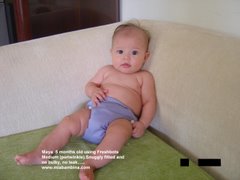
So this is just to share my washing routines, and I got repeating questions about washing and what is correct to do and what is not. I am not an expert and still far from that. I just join a few numbers of Cloth diaper group and gather some infos here and there, and the most important is I try it my self . But again my needs and my baby needs are not the same like yours. So you should find what is work for you and suitable for your lifestyle too. You might find many tips over the internet about washing cloth diapers and you can try and adapt it too suit your needs.

The best tips that I got so far is: try the simplest routine and if it's works for you and your baby just stick with that. If you find some problem on the way ( rashes, smell, leakage) you might need to adjust your routine or change your detergent.

First is detergent, any detergent without additives like softener, bleach, brightener , enzyme will do fine. And make sure you use 1/4 of recommended amount. And the water level of the washing machine also must be higher than the load. Avoid to wash more than 12 diapers plus inserts at one time.
The detergent , of course , you must adjust if your babies have any reaction to any particular detergent. Some are just doing great with any basic detergent , but some find it too harsh on baby's skin. Some moms love Pureen HAD (not ABD) and they been using it for a while and both babies and diapers are doing great. :-)

Second is soaking vs not soaking. If you think you need to soak to remove any smell or stain you can do that. Soaking with baking soda will help to remove stubborn stain and odor. Personally I don't soak my baby's diapers. Just rinse if it soiled and put in to pail/wetbags till washing time.

A help full articles form diaper pin about baking soda & vinegar

REMOVING URINE SMELL
Include baking soda when washing or soaking your cloth diapers.

If you use baking soda in the wash or soak, make sure to use vinegar in the rinse, This will help restore the pH of the cloth diapers. Otherwise your baby may end up with diaper rash.
The baking soda neutralizes acidic odors, removes acid and protein based stains, and softens the diapers.

About vinegar ( again from diaper pin)
You may be wondering if the use of distilled white vinegar is truly essential in your cloth diaper wash. After all, there seems to be such a good amount to remember as it is, and if you can cut something out of the routine, vinegar seems to be the most viable option.
Well, let us give you some of the attributes of vinegar. And, we are talking distilled white vinegar NOT apple cider vinegar or any other type of vinegar. (Apple cider vinegar will cause your diapers to discolor and become dingy looking.) If you use it at all, you must use distilled white vinegar.

"Heads-Up": The reasons to use vinegar:
o Vinegar will help neutralize the urine in cloth diapers.
o Vinegar equalizes pH balance.
o Vinegar helps eliminate soap residue/film build-up.
o Vinegar deters the setting-in of stains.
o Vinegar can help keep colors from bleeding.
o Vinegar can cut down on lint.
o Vinegar is a natural fabric softener and static cling reducer.

"Tails": The reasons to NOT use vinegar:
o In some areas with 'hard water,' there is a chance that vinegar can mix with trace minerals in your water supply, causing your diapers to smell acrid once urinated upon. In which case, you would want to cease using vinegar in your diaper pail/wash.
o If you notice a build-up of residue on your diapers or your diapers are not as absorbent AND YOU HAVE NOT been using DREFT or any other detergent with fabric softeners built-in, temporarily cease your use of vinegar. In this situation, vinegar might not be the culprit, but once there is a build-up on your diapers, they will need to be'stripped' before you should continue regular usage of vinegar.
o If you notice that your diaper covers are getting stinky, vinegar may be the culprit. Many of today's diaper covers have some polyester in them and polyester easily holds in smells. Vinegar's acidity can react to baby's acidic urine and together, they can release a very acrid smell.


Personally I don't use baking soda and vinegar everyday. I use it once a week. I use dettol into my wash every day, just a cap full. And I 've been doing that for over a year. My cloth diapers are just still great. I use the multi purpose dettol, the kind that been use in the hospital to disinfect linens.

Another tips about washing ( and to prolong your cloth diaper life span)
-If your inserts are not that white ( and that is normal) you can try to use 1/2 cup of lemon juice to brighten them.
-You might want to wash your clean diaper stash in the washing machine with hot water without detergent , just to remove any detergent build up or
-Washing them in the washing machine with a bit of DISHWASHING liquid . This will consider as strip washing, and can be done every 2 weeks or every month.
Otherwise if you strip wash like in my previous blog ( how to strip wash cd)
-Try to hang dry diapers under the sun or air dry over night under ceiling fan will do great for rainy season
- If you use fitted diapers, it will be better if you hang it horizontally, just to prevent the elastic be dragging down while it is wet and more heavy.
-if your diaper got "poo" stain, try to rinse it with cold water. Hot water will set stains in.
- I just read an interesting articles about using too much detergent actually can be the cause of cloth diapers smelling bad. The reason is, the old detergent residue stays in the diaper and mix with urine smell can produce a bad smell and when it is wash it will have more detergent and this will goes on and on...In contrary of the idea , using more detergent will get rid of bad smell, actually it will make it worst. The remedy: try to wash the diapers ( clean) without any detergent in the washing machine until the water run clear and no more suds. Hot or cold water will do.
And you can add baking soda or vinegar in the last wash. Or the next wash.

Diaper rash.

Most of the time diaper rash come from laundry's or wash routine.
You should pay attention on your routine or your detergent. Mostly is because of detergent build up. So strip washing usually will solve this. ( you can choose any of the strip washing method and see which is more suitable)
Try to avoid any thick cream diaper ointment to be use with Cloth diaper, if you must use this, you can use nappy liner, just to create a barrier between the cream and the diaper. The reason is the thick diaper cream will leave a creamy film on the diaper can cause diaper to repel urine and leak.

Some babies are allergic to synthetics fabrics. So if you stick to natural material ( like hemp or bamboo) that will be the best for those babies.

Baby's diet also might trigger rashes, if you baby is just into solid food you might want to pay attention to that.

Change your baby's diaper more often, use breathable cover ,like wool, or leave him without cover.

Some times the wet wipes can be too harsh on baby's skin. Try to use soft cloth wipes or cotton ball with water.

If diaper rash persist you should contact your pediatrician .

Experiment and learn from other moms or searching form the Internet can give your more ideas. I just been so greatfull that many moms wrote to me with questions and tell me what routine works for their families. It's just open my eyes and let me see from other's point a view .

Again this post is just from a mom to other moms out there and from the cloth diapering books that I have and read.I just want to share some tips and I gathered informations and share what it work for me and hopefully you will find it useful too.
I am not a cloth diaper's expert or what so ever...again far away from that :) I am just a cloth diapers lover and user. And I share these tips and write my blog just to share my passion about it, and wish to spread the words and goodness about cloth diapers locally. I think it deserves more attention . The most important is I am doing my part to protect our environment in a small tiny step.

If you got some more ideas and tips to share, or some more opinion about the products or that I carry I would love to hear from you. I couldn't be any better without your support and feedback (good or bad)

To learn is to change and accepted new ideas , I am still learning and just a beginner in the cloth diapering world compare to those wonderful Cloth diapers biz owner overseas and also in Malaysia and neighboring country . But I believe when most of Cloth diapers moms share and give extra tips, we can always find a better solution on our cloth diaper's journey and make in more pleasant.

Additional notes: if you find Dettol is to harsh for your baby you don't need to use that for every wash ,once a week will do. I just use a cap full of it , diluted in a high level of water in the washing machine. You can adjust the frequency according to your need
Have a great weekend with your love ones!

from me...